
In Touch Rolls Out New Case Management System, ERIC
Our new Case Management System, Enterprise Resource Information and Control (ERIC), is now LIVE!
Written by Graduate Intern Christina I. Brodeth | Clinically Reviewed by Dr. Andrew Stephen Lim

Content warning: This article discusses suicide. Please proceed with caution, or consider skipping this post if it may be distressing.
If you are in need of immediate emotional support, our 24/7 Crisis Line is here to support you.
A great deal of misinformation and a lacking awareness of suicide as a major problem of public health keeps it from being adequately addressed. With many societies today still considering the issue taboo, the World Health Oganization (2025) reports suicide is the third leading cause of death, specifically among those aged 15-29 (accidents and homicide before it), claiming the lives of 720,000 people each year. And while the link between mental disorders (i.e., mood disorders, substance abuse) and suicidality is well-established, the former is not the sole cause of the latter.
There is a complex interplay between predisposing factors in an individual’s biology, personality, and cognitive vulnerabilities—and in conjunction with exposure to stressful life events (e.g., financial problems, conflicts in relationships, exposure to violence and abuse), experiencing crises (e.g., disasters—whether natural, man-made, or a global pandemic), and even chronic pain and illness (leading to progressive feelings of isolation and loss of normalcy) all further increase and aggravate the risk of destructive behaviors towards the self. Understanding the importance of the social environment and its role in suicide and suicide prevention is a key factor to consider.
The stigma surrounding suicide and the illegality of suicidal behavior in some countries likely causes underreporting and misclassification of many cases, undermining the urgency by which this issue should be treated. Studies have observed that suicidal behaviors fluctuate between active or passive contemplation, or choosing to accept death by suicide through purposely disregarding their well-being and denying self-preservation.
We can steadily work to stop the reproachful stance that is generally taken when discussing the issue. Speaking up and clearing the misunderstandings about suicide and those at risk, can hopefully shift the perspective to one which holds kindness and consideration towards those struggling in high regard. Many people are fighting battles we cannot see, whether it be a mental illness or being under extreme strain, and they may not know how to cope in a healthy way, nor have a good support system to turn to. In advocating for an open discussion on suicide and mental health awareness, it provides a safe space and can help those who want to seek professional treatment. It is critical for suicide prevention programs to effectively address and correct suicide myths and misconceptions.

Challenges to suicide literacy and suicide prevention are fueled by misconceptions that contribute to false beliefs and stigmatizing attitudes towards individuals at risk, as these behaviors: a) disincline their willingness to seek professional help, and b) counteract proper mental health education for the general population. Research has shown a reciprocal relationship that exists between stigma and suicide: suicide can cause stigmatizing behaviors, but stigma toward mental disorders also poses as a risk factor for suicidality. By a large extent, victims of suicide and attempted suicide are perceived as selfish, attention-seeking, weak, and lacking the ability to cope with stressors. In turn, stigma has other forms (i.e., racial discrimination, internalized shame, deprioritization of mental health care) that can exacerbate a person’s situation and cause extreme psychological distress, and consequently some come to regard suicide as a way out from the stigma. While there is still a lot of work to do before the narrative on suicide and mental health can be reformed, it is relevant nonetheless, to help build change in the societal perception of these issues for the future.
To start, here are some common myths and misconceptions revolving around suicide:
However, active suicidal ideation is often short-term and situation-specific, and does not always escalate even if suicidal thoughts return. Many individuals who have struggled with suicidal ideation or a past attempt can absolutely live fulfilling lives beyond their past suffering. They can seek professional treatment and therapeutic intervention to help manage their personal struggles, which in time and with patience, can get better.
It is always worth it to reach out and offer help to find the support needed. While people will do what they want to do, we can still try to lessen a person’s burden. It doesn’t have to be complicated; a simple and effective part of suicide safety is just being nearby, and being present for them. Suicide is ultimately preventable. Hence, there is nothing to lose by lending a helping hand and letting people know you will be there for them when they need you, and even when they don’t.

Mental health literacy
It is important for us to constantly adapt and stay updated with current events, as we push against barriers that keep mental health on the backburner. Mental health literacy, specifically suicide literacy, is a necessary skill we can all learn. Suicidality can be prevented, in raising awareness and providing the correct information about suicidal behavior, knowing the possible warning signs, and how to offer support. In shifting the harmful lens toward suicide into a more accepting and compassionate view, it is improved suicide literacy which has proved beneficial to lowering levels of stigmatizing attitudes and reinforces more help-seeking behavior. How we talk about suicide matters, and confronting the misconceptions in relation to it allows for a change in perspective, including being mindful of the language we use. The Canadian Association For Suicide Prevention (2024) recommends more neutral terminology, such as death by suicide, suicide, suicide attempt as opposed to commit suicide, successful suicide, and failed suicide attempt—to help advocate for a more compassionate and open-minded dialogue surrounding suicide.
Media influence
The media is a powerful resource in the education and dissemination of information to the public regarding mental health issues, including suicide. Accurate and reliable information about suicide should be accessed from highly reputable and knowledgeable sources (e.g., health organizations, mental health professionals), and to avert the notion of suicide being an acceptable occurrence. Promoting safe use of social media (i.e., openness in family communications), when done with competence and compassion, enhances the essential role media plays in suicide prevention. In line with this, we should not lose sight of the fact that it is also very much the responsibility of policy-makers and social media companies to secure a safer online environment.
Everybody matters
Everybody matters, and for people to feel they are important to those around them, cared about, and depended on, is a comforting and protective resource that lessens the susceptibility to negative life events. A common feeling shared by suicidal individuals is that they do not matter, and studies have shown that when someone genuinely believes they are insignificant in their relationships (i.e., friends, family) and in their environment (e.g., school, place of work), there is a high risk for suicidality. To feel devalued as a person, to perceive that others are indifferent to you, these feelings may become a source of psychological pain. This makes it crucial to have quality interactions with people, to give them support so they truly feel that they matter and are understood.
Having the knowledge to identify signs and symptoms of good and bad mental health, recognizing the need for professional help, and aiding in the prevention of mental illness—is all so we can take better care of ourselves and our communities.
References:
Balt, E., Mérelle, S., Robinson, J., Popma, A., Creemers, D., van den Brand, I., van Bergen, D., Rasing, S., Mulder, W., Gilissen, R. (2023). Social media use of adolescents who died by suicide: lessons from a psychological autopsy study. Child and Adolescent Psychiatry and Mental Health, 17(1). https://doi.org/10.1186/s13034-023-00597-9
Beautrais, A. L., Horwood, L. J., & Fergusson, D. M. (2004). Knowledge and Attitudes about Suicide in 25-Year-Olds. Australian & New Zealand Journal of Psychiatry, 38(4), 260–265. https://doi.org/10.1080/j.1440-1614.2004.01334.x
Calear, A. L., Batterham, P. J., & Christensen, H. (2014). Predictors of help-seeking for suicidal ideation in the community: Risks and opportunities for public suicide prevention campaigns. Psychiatry Research, 219(3), 525–530. https://doi.org/10.1016/j.psychres.2014.06.027
Canadian Association For Suicide Prevention. (n.d.). Vocabulary–how to talk about suicide. https://suicideprevention.ca/resource/vocabulary-how-to-talk-about-suicide/
Carpiniello, B., & Pinna, F. (2017). The reciprocal relationship between suicidality and stigma. Frontiers in Psychiatry, 8(35). doi: 10.3389/fpsyt.2017.00035
Cerwenca, V. F. (2025). The effectiveness of the Truth-Sandwich approach on debunking suicide myths, considering participants’ mentalizing ability and emotional state [Masters Thesis, Alpen-Adria-Universität Klagenfurt]. Alpen-Adria-Universität Klagenfurt Repository. https://netlibrary.aau.at/urn/urn:nbn:at:at-ubk:1-58442
Flett, G. L. (2024). Mattering matters in youth suicidality: Implications for implementing in practice. Child Protection and Practice, 2, 100041. https://doi.org/10.1016/j.chipro.2024.100041
Fuller, K. (2020, September 30). 5 Common myths about suicide debunked. NAMI. https://www.nami.org/stigma/5-common-myths-about-suicide-debunked/
Hawton, K., Saunders, K. E., & O’Connor, R. C. (2012). Self-harm and suicide in adolescents. The Lancet, 379(9834), 2373–2382. https://doi.org/10.1016/s0140-6736(12)60322-5
Nevada Division of Public and Behavioral Health. (n.d.). Suicide prevention. Office of Suicide Prevention. Retrieved September 7, 2025, from https://www.dpbh.nv.gov/programs/suicideprevention/
Niederkrotenthaler, T., Reidenberg, D. J., Till, B., & Gould, M. S. (2014). Increasing Help-Seeking and referrals for individuals at risk for suicide by decreasing stigma. American Journal of Preventive Medicine, 47(3), S235–S243. https://doi.org/10.1016/j.amepre.2014.06.010
Procentese, F., Gatti, F., & Di Napoli, I. (2019). Families and Social Media Use: The Role of Parents’ Perceptions about Social Media Impact on Family Systems in the Relationship between Family Collective Efficacy and Open Communication. International Journal of Environmental Research and Public Health, 16(24), 5006. https://doi.org/10.3390/ijerph16245006
Rogers, K. (2022, September 10). Debunking myths about suicide helps encourage compassion and understanding. CNN Health. https://edition.cnn.com/2022/09/10/health/suicide-myths-facts-prevention-wellness
Rogers, K. (2024, September 10). What you should know about the ‘silent epidemic of suicide’. CNN Health. https://edition.cnn.com/2024/09/04/health/suicide-prevention-month-important-facts-wellness
Rosenberg, M., & McCullough, B. C. (1981). Mattering: Inferred significance and mental health among adolescents. Research in Community and Mental Health, 2, 163–182.
Schurtz, D. R., Cerel, J., & Rodgers, P. (2010). Myths and facts about suicide from individuals involved in suicide prevention. Suicide and Life-Threatening Behavior, 40(4), 346–352. https://doi.org/10.1521/suli.2010.40.4.346
Šeibokaitė, L., & Genutytė, D. (2015). The content of comments on articles describing suicide: Searching for causes, attitude, myths. Psichologija, 51, 44–57. https://doi.org/10.15388/psichol.2015.51.8255
Strukcinskienė, B., Strukcinskaite, V., & Rauckiene-Michaelsson, A. (2019). The links between suicidal behaviour and endorsement of myths about suicide in young people. Social Welfare Interdisciplinary Approach, 9(1), 57-68. https://doi.org/10.21277/sw.v1i9.448
Till, B., Wild, T. A., Arendt, F., Scherr, S., & Niederkrotenthaler, T. (2018). Associations of tabloid newspaper use with endorsement of suicide myths, suicide-related knowledge, and stigmatizing attitudes toward suicidal individuals. Crisis: The Journal of Crisis Intervention and Suicide Prevention, 39(6), 428-437. https://doi.org/10.1027/0227-5910/a000516
Turecki, G., Brent, D. A., Gunnell, D., O’Connor, R. C., Oquendo, M. A., Pirkis, J., & Stanley, B. H. (2019). Suicide and suicide risk. Nature Reviews Disease Primers, 5(1). https://doi.org/10.1038/s41572-019-0121-0
World Health Organization. (2014, August 17). Preventing suicide: a global imperative. https://iris.who.int/handle/10665/131056
World Health Organization. (2025, March 25). Suicide. https://www.who.int/news-room/fact-sheets/detail/suicide
Wyman, P. A. (2014). Developmental approach to prevent adolescent suicides: research pathways to effective upstream preventive interventions. American Journal of Preventive Medicine, 47, S251–S256. doi:10.1016/j.amepre.2014. 05.039
Zaborskis, A., Sirvyte, D., & Zemaitiene, N. (2016). Prevalence and familial predictors of suicidal behaviour among adolescents in Lithuania: a cross-sectional survey 2014. BMC Public Health, 16(1). https://doi.org/10.1186/s12889-016-3211-x
Our new Case Management System, Enterprise Resource Information and Control (ERIC), is now LIVE!

Understanding and celebrating diversity in relationships, identities, and expressions is vital in creating inclusive and supportive environments. This module, Inspiring PRIDE, focuses on promoting mental
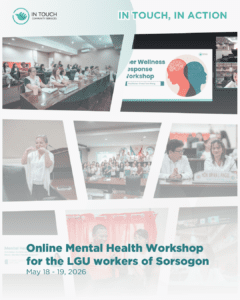
Last May 18 – 19, 2026, we had the privilege of conducting an Online Mental Health Workshop for the dedicated LGU workers of Sorsogon. Together,
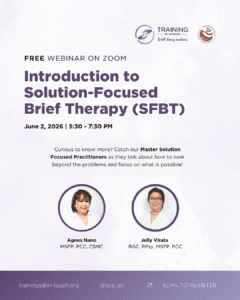
In Touch Community Services, Inc. is inviting all mental health professionals and HR practitioners to join us for a FREE webinar on the Introduction to
Written by Graduate Intern Christina I. Brodeth | Clinically Reviewed by Dr. Andrew Stephen Lim Content warning: This article discusses suicide. Please proceed with caution,

For any immediate or in-the-moment emotional support, call our 24/7 CRISIS LINE. Our professionally trained responders are on standby to assist you.


